Call us Anytime
+8613570976228



What Is an Air Source Large Horizontal Integrated Type Ozone Generator and How Does It Work?
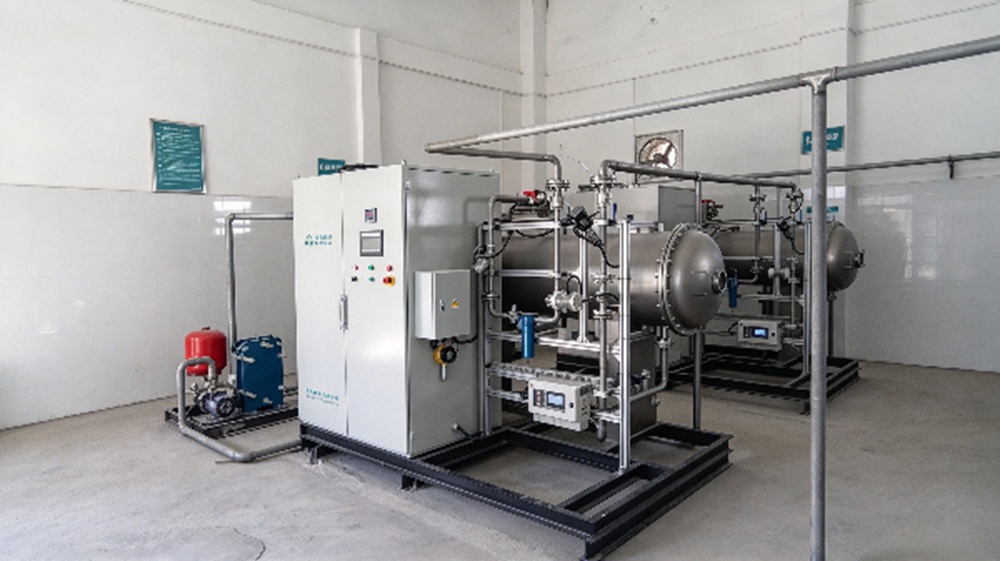
An Air Source Large Horizontal Integrated Type Ozone Generator is a high-capacity, self-contained system. It produces ozone from ambient air for industrial water treatment and air purification. These ozone generators combine generation, cooling, and control on one skid-mounted base. Large horizontal ozone generators save space and simplify service access. Each generator delivers dependable ozone output.
An air source large horizontal integrated type ozone generator uses ambient air to produce ozone, saving the cost of an oxygen supply.
The generator creates ozone through a corona discharge process that splits oxygen molecules and forms ozone gas.
Proper safety measures, such as ventilation and monitoring, are essential because ozone can be harmful at high levels.
An air source large horizontal integrated type ozone generator draws ambient air as its feed gas. This design uses the oxygen naturally present in the air. You avoid the cost and logistics of a separate oxygen supply. The trade-off is clear. Dry-air ozone generation generally operates at lower ozone concentration, higher total gas flow for the same ozone mass production, and higher specific energy demand for ozone generation. For many industrial sites, this trade-off is acceptable. The system needs no liquid oxygen tank or pressure swing adsorption plant. You get a simpler, more independent operation.
The integrated horizontal layout places every subsystem on one skid-mounted base. Air preparation, ozone generation, cooling, and control all sit together. A horizontal arrangement gives you convenient access for servicing. You can reach components without dismantling the stack. Esegen's air source large horizontal integrated type ozone generator follows this pattern. The unit features robust construction for demanding industrial applications. A typical skid measures 2,820 mm long and weighs about 2,313 kg. The design carries UL 508A Listing. This air source large horizontal integrated type ozone generator suits medium to large scale ozone generation systems where air-fed operation is technically and economically viable.
The table below summarizes the physical and operational specifications of this integrated horizontal generator unit:
|
Feature / Parameter |
Technical Specification |
|---|---|
|
Feed Gas Source |
Ambient Air (Air-fed operation) |
|
Layout Configuration |
Integrated horizontal, skid-mounted base |
|
Physical Length |
2,820 mm |
|
Approximate Weight |
2,313 kg |
|
Safety Certification |
UL 508A Listing |
A complete ozone generation system includes several core parts. The ozone generator itself is the heart. A feed gas system supplies either air or oxygen. An ozone contactor, such as a contact tank with diffusers, mixes the gas into water. An ozone destructor eliminates trace ozone after treatment. A control system ties all components together for automatic operation. For air-fed units, you also need a fresh air supply and control provision to keep incoming air clean. A closed-loop recirculating cooling system keeps the air cool. A high-frequency power supply energizes the reactor chamber. The proprietary ozone reactor chamber creates ozone gas. An applicator assembly spreads the ozone gas throughout the target space. Optional add-ons include an air dryer for further moisture reduction and an ozone monitor for continuous output tracking.
These ozone generators serve many industrial duties. You find ozone generators in water treatment, air purification, and process oxidation. Industrial ozone generators must handle continuous duty. Many ozone generators rely on ambient air for cost control. Other ozone generators use oxygen feed for higher concentration. Your choice among oxygen generator types depends on your output target. An oxygen generator system adds capital cost. Integrated oxygen generators combine feed and generation on one frame. Industrial oxygen generator systems often serve high-demand sites. Medium to large scale ozone generation systems balance cost and capacity. This air source large horizontal integrated type ozone generator fits that balance. You should match the generator to your production needs and safety requirements.
The table below breaks down the primary sub-systems and optional add-ons utilized in a complete industrial ozone layout:
|
Component Category |
Specific Part / Subsystem |
Core Function |
|---|---|---|
|
Core Generation |
Ozone Reactor Chamber & High-Frequency Power Supply |
Energizes feed gas to create ozone gas via corona discharge |
|
Process Control & Safety |
Ozone Destructor & Optional Monitor |
Eliminates trace ozone post-treatment and tracks continuous output |
|
Support & Conditioning |
Closed-Loop Cooling & Optional Air Dryer |
Keeps the air cool and reduces moisture to protect efficiency |
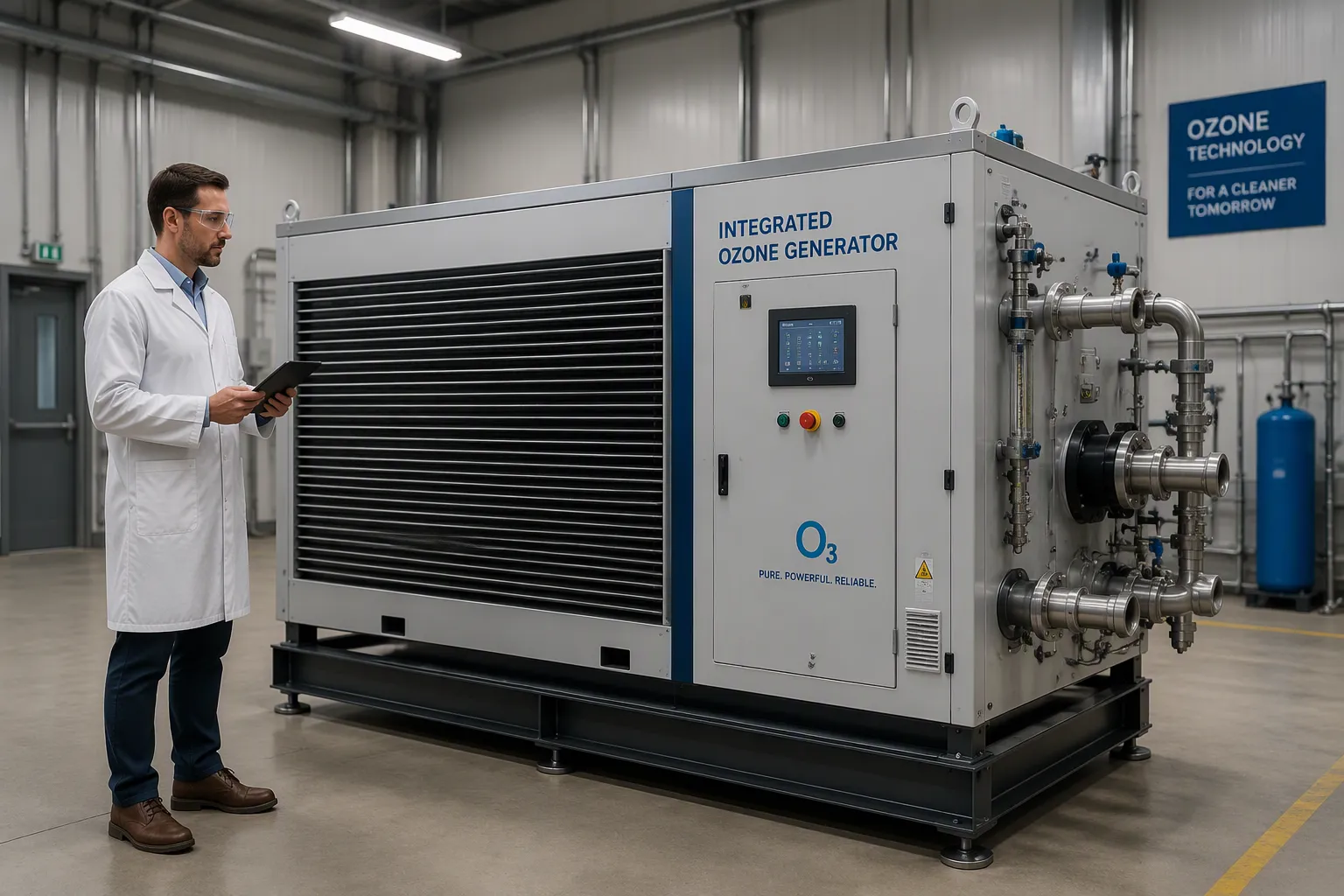
You can trace the whole process in four stages. First, the system pulls ambient air through an intake. Second, filters remove dust and particulates. Third, a dryer strips moisture, because humidity degrades efficiency. Fourth, the conditioned air enters the reactor, where a silent corona discharge does the chemistry.
A high-voltage electric field tears oxygen molecules apart. Each split oxygen molecule separates into two oxygen atoms. These free oxygen atoms are unstable and highly reactive. They quickly attach to intact oxygen molecules nearby. The result is ozone gas, written as O₃. This is how ozone generators produce ozone from ordinary air. The silent corona discharge method is the dominant approach in industrial ozone generators because it is reliable and scalable. Esegen builds this generation stage into its Advanced Oxidation Process Technology portfolio, pairing robust reactors with matched power supplies.
The four sequential stages of air preparation and conversion into ozone are outlined below:
|
Stage Sequence |
Action / Subsystem |
Technical Objective |
|---|---|---|
|
Stage 1 |
Air Intake |
Pulls raw ambient air into the system boundary |
|
Stage 2 |
Filtration |
Removes dust and particulate contaminants |
|
Stage 3 |
Drying |
Strips moisture to prevent drops in efficiency |
|
Stage 4 |
Reactor Chamber |
Applies silent corona discharge to synthesize O₃ |
Ozone is a powerful oxidizer. It breaks down organic pollutants, bacteria, and odors effectively. That strength demands controlled environments. Industrial ozone generators must run with monitoring and ventilation in place.
Regulators set clear exposure ceilings. Review the key limits below.
Worker Limits: Worker limits vary by source and workload. OSHA's PEL is 0.1 ppm as an 8-hour TWA. NIOSH sets a 0.1 ppm ceiling that must never be exceeded, plus an IDLH of 5 ppm. ACGIH thresholds tighten with physical effort: 0.05 ppm for heavy work, 0.08 ppm for moderate work, 0.10 ppm for light work, and 0.20 ppm for any workload lasting two hours or less.
Ventilation & Detection Codes: Model fire code language, as adopted in section 6005.3.2 of the New York City Fire Code, requires ozone gas generator rooms to be mechanically ventilated and "equipped with a continuous gas detection system which will shut off the generator and sound a local audible and visible alarm when concentrations above the permissible exposure limit occur."
Short-Term Limits: No federal short-term limit currently applies. OSHA's 1989 rule set a 0.3 ppm STEL, but the Eleventh Circuit vacated it in 1992. California is the exception: Cal/OSHA's 8 CCR 5155 keeps both a 0.10 ppm PEL and a 0.30 ppm STEL.
The regulatory exposure limits and thresholds across various authorities are compiled in the table below:
|
Regulatory Body / Code |
Limit Type & Value |
Notes / Conditions |
|---|---|---|
|
OSHA |
0.1 ppm |
Permissible Exposure Limit (PEL) as an 8-hour TWA |
|
NIOSH |
0.1 ppm ceiling / 5 ppm IDLH |
Ceiling must never be exceeded |
|
ACGIH |
0.05 to 0.20 ppm |
Varies based on physical effort intensity and duration |
|
Cal/OSHA (8 CCR 5155) |
0.10 ppm PEL / 0.30 ppm STEL |
Maintains both long-term and short-term state standards |
Safe operation follows four practices:
Destroy off-gases before release.
Treat small leaks as serious, since a tiny leak can push ambient levels too high.
Check routinely.
Keep monitoring equipment calibrated.
Esegen's Exhaust Destroyer decomposes residual ozone before release. A 2005 NIOSH evaluation measured welding ozone exposures up to 0.7 ppm, seven times the NIOSH ceiling — proof that unmonitored sources escalate fast.
This air source large horizontal integrated type ozone generator gives you a robust, self-sufficient answer to large-scale ozone needs. It draws ambient air, filters it, dries it, fires corona discharge, and releases ozone. Industrial ozone generators still demand correct sizing, ventilation, and monitoring. Ozone generators like Esegen's pair well with the Exhaust Destroyer for Ozone Generator. Ask an ozone generator specialist to match your generator to your oxygen-free duty and safety limits. Many industrial ozone generators, and most ozone generators, reward careful planning. Air-fed ozone generators suit you when air supply and safety planning align.
Yes. These ozone generators draw ambient air, so you skip oxygen supply costs. Esegen builds ozone generators for demanding sites. Ozone output stays steady.
Clean the air filters and check the dryer. Monitor the cooling loop. Well-kept ozone generators last longer. Log ozone levels during each service. Test ozone generators after every repair.
Match ozone generators to your flow rate and pollutant load. Confirm air quality and ventilation first. Ask Esegen to size ozone generators for your duty. Properly sized ozone generators protect safety and output.
Copyright @ Esegen (Guangzhou) Technology Co., Ltd All Rights Reserved.
 Network Supported