Call us Anytime
+8613570976228



A finding that fully aligns with the technical principles of Magnetic Fenton technology.
Research conducted by the Chinese Academy of Sciences has confirmed that magnetic fields can reconfigure the structure of water molecules—a finding that fully aligns with the technical principles of magnetic Fenton technology.
In July 2025, the Institute of Process Engineering at the Chinese Academy of Sciences published a research breakthrough: Professor Wang Zhi's team proposed and validated a strategy titled "Strong Magnetic Field-Induced Reconstruction of Hydrogen Bond Networks in Electrolytes." The magnetic field precisely regulates ion hydration structures and the orientation of water molecules at interfaces through the Paschen-Back effect, significantly enhancing both reaction rates and stability at these interfaces. These findings were published in the prestigious international journal Nature Communications.
Scientific Principle: Magnetic fields alter the structure of water molecules
Research conducted by the Institute of Process Engineering at the Chinese Academy of Sciences has confirmed:
Strong magnetic fields can precisely reconstruct the hydrogen bond network in aqueous solutions, modulate the structure of ion hydration and the orientation of interfacial water molecules, and optimize solvation kinetics. Utilizing this principle, the research team achieved a reduction in energy consumption by approximately 15% in the water electrolysis hydrogen production system.
In simple terms: magnetic fields can alter the microscopic structure of water molecules, thereby significantly enhancing reaction efficiency!
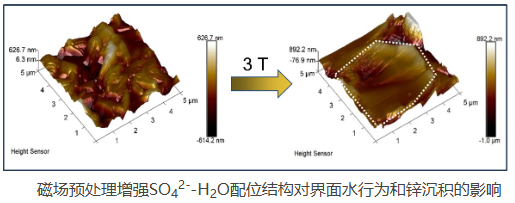
Note: The above content is excerpted from the official website of the Chinese Academy of Sciences; the article link is provided at the end of this document.
This principle is almost entirely consistent with the core logic of Magnetic Fenton Technology. The technology is precisely based on this scientific rationale—utilizing magnetic fields to alter the arrangement of water molecules in wastewater, thereby exposing originally encapsulated organic pollutants and significantly enhancing the utilization efficiency of hydroxyl radicals.
Magnetic Fenton: Replacing "brute force" with "smart approaches" to achieve scientific cost reduction and efficiency improvement
Traditional Fenton process / Fluidized-bed Fenton process
Hydroxyl radicals cannot readily access COD molecules encapsulated within water molecule clusters; they can only achieve effective neutralization by adding an excess of hydrogen peroxide through a "saturation attack."
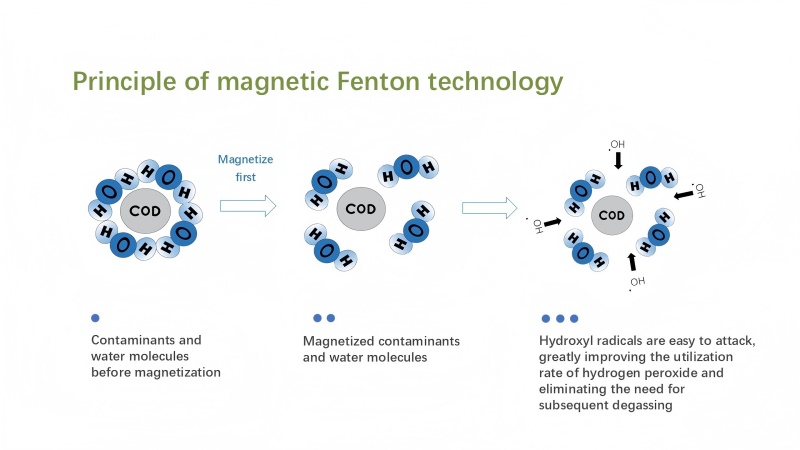
Engineering characteristics: significantly excessive hydrogen peroxide concentration → mandatory degassing in subsequent stages → hydraulic retention time of 2–4 hours → large tank volume requiring substantial space
Magnetic Fenton
Wastewater flows through the magnetic field region → The binding state between pollutants and water molecules changes → Hydroxyl radicals readily interact with COD molecules:
Engineering Features: No excess hydrogen peroxide required → No subsequent degassing needed → Hydrodynamic retention time of only 1 hour → Compact tank design with minimal space occupation
In summary: Traditional Fenton employs brute force for comprehensive treatment, while Magnetic Fenton uses precision-based approaches for targeted elimination.
Numerous engineering cases demonstrate: Under identical influent conditions, the advantages of Magnetic Fenton process are immediately evident.
The MagFenton technology has been successfully implemented in wastewater treatment projects across dozens of industrial parks nationwide, serving high-strength wastewater industries including papermaking, pharmaceuticals, dyeing and printing, chemicals, pesticides, membrane concentration processes, coking, leather processing, and food manufacturing, with a large number of projects distributed widely.
In projects with similar influent conditions (such as the Yudong Wastewater Treatment Plant in Datong, Shanxi Province), magnetic Fenton processes stand in direct contrast to fluidized-bed Fenton processes: they significantly reduce chemical consumption, energy usage, land footprint, and operational maintenance requirements while markedly improving treatment efficiency—with advantages that are clearly evident.
Copyright @ Esegen (Guangzhou) Technology Co., Ltd All Rights Reserved.
 Network Supported