Call us Anytime
+8613570976228



How does the on-site sodium hypochlorite production system make the operation and maintenance of water plants more convenient and worry-free?
How does the on-site sodium hypochlorite production system make the operation and maintenance of water plants more convenient and worry-free?
In the disinfection phase of water treatment plants, on-site sodium hypochlorite generation technology has long achieved "immediate production and immediate use," effectively mitigating the transportation and storage risks associated with conventional commercial chlorine. However, in actual operation and maintenance, many water treatment plants still face challenges such as frequent equipment inspections, reliance on manual parameter adjustments, and time-consuming fault diagnosis. As the trend toward digitalized and minimally staffed operation in water treatment plants accelerates, the level of equipment intelligence is becoming a key determinant of operational and maintenance efficiency and cost.
The on-site sodium hypochlorite production system not only delivers outstanding performance in terms of safety and cost-effectiveness, but also, through intelligent features such as fully automated control, remote monitoring, and data-based diagnostics, enables water treatment plant operations and maintenance to transition from "manual equipment monitoring" to "cloud-based intelligent management."
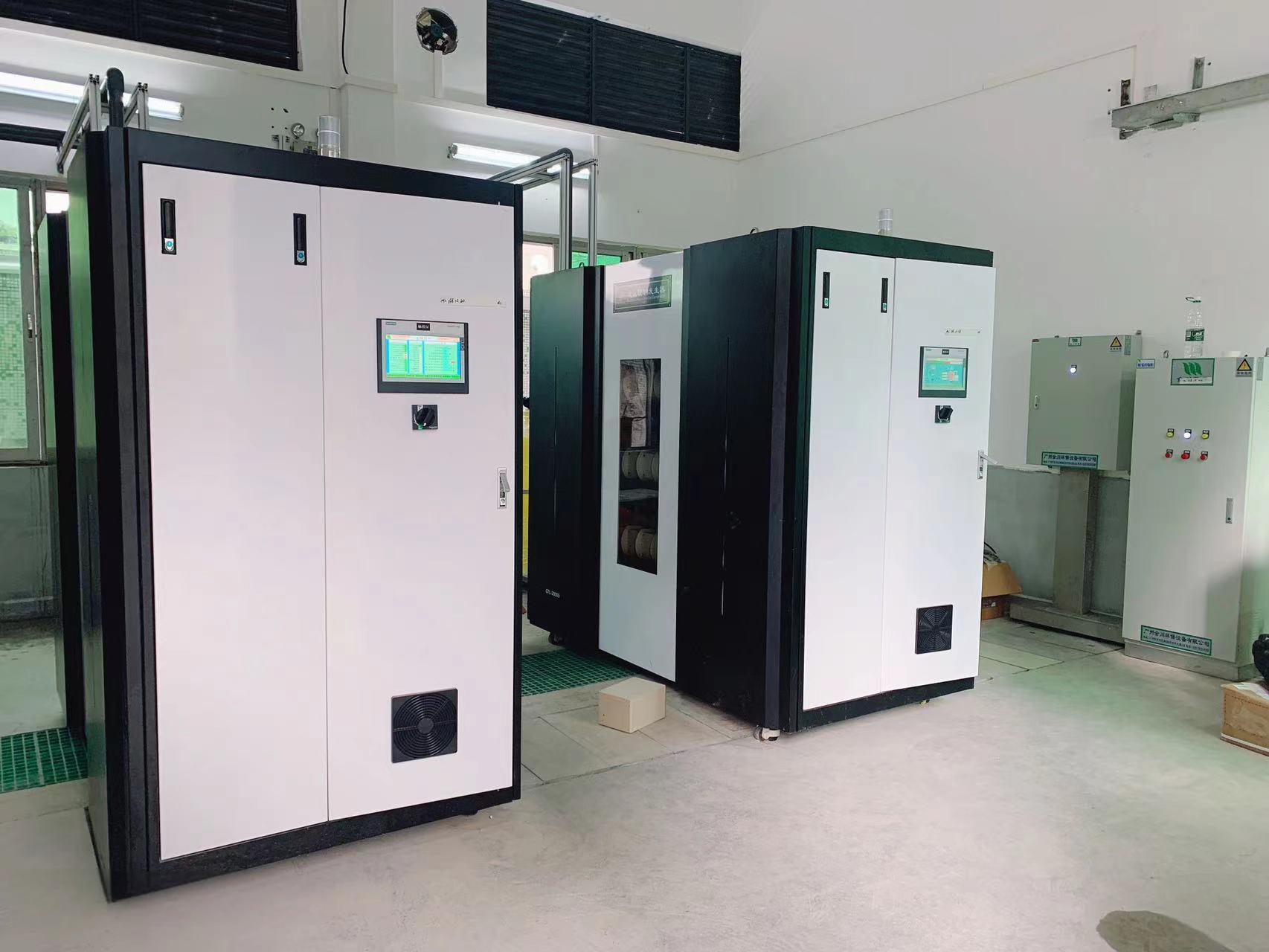
The sodium hypochlorite preparation system incorporates a highly integrated automated control platform that can automatically adjust key parameters—including electrolytic current, brine flow rate, and dilution water flow rate—in accordance with preset production requirements, eliminating the need for frequent manual intervention throughout the process.
Real-time monitoring: alerts triggered by anomalies
The system continuously collects operational data, including electrolysis voltage, current, temperature, and trends in chlorate generation; once any deviation from the normal operating range is detected, local and remote alarms are triggered immediately, and an event log is recorded to facilitate traceability and analysis.
One-touch start/stop—ultra-simple operation
Through an intuitive human-machine interface (HMI), operators can simply tap the screen to initiate system startup, shut down the system, or modify parameters. The equipment automatically executes the entire process—including self-diagnosis upon startup, electrolysis, shutdown, and continuous hydrogen venting—thereby significantly reducing reliance on the operators' specialized experience and shortening the training period for new employees.
The sodium hypochlorite production system supports integration with industrial internet platforms, enabling operational data to be uploaded to the cloud in real time. This means that both the central control room of a water treatment plant and the Dinola Technical Service Center can remotely monitor the real-time status and historical trends of the equipment.
Early warning of potential faults
Based on built-in monitoring, the system can issue early warnings for potential issues such as electrode scaling, abnormal salt consumption, fluctuations in hydrogen concentration, and a decline in rectifier efficiency. Maintenance personnel no longer need to conduct daily "diagnoses" based on experience; instead, they can carry out targeted maintenance actions according to the maintenance recommendations provided by the system.
Expert remote assistance to minimize downtime
When complex faults occur, the Dinora technical team can log in remotely to assist on-site personnel in rapidly diagnosing the root cause of the problem and providing guidance for replacing spare parts or adjusting parameters. Many faults that previously required on-site service by manufacturer personnel can now be resolved remotely within a few hours, significantly shortening the average repair time and reducing travel costs.
The system automatically records operating data on a daily, weekly, monthly, and even quarterly basis, generating visualized charts such as electrolysis voltage trend graphs, salt consumption curves, and chlorate generation reports. Operations and maintenance personnel can therefore intuitively monitor equipment performance degradation patterns, anticipate the appropriate timing for electrode replacement, and mitigate the risk of sudden shutdowns.
Optimization recommendations based on similar operating conditions
We have accumulated operational databases for thousands of on-site chlorine production systems worldwide. For the same water quality, temperature, and production conditions, the system can compare and analyze differences between the operating parameters of the current equipment and those of typical models, proactively providing energy-saving recommendations or maintenance alerts. For example, when the brine flow meter exhibits drift, the system prompts the user to calibrate it; when electrolysis efficiency falls below the expected value, the system recommends inspecting the electrode coating or the quality of the brine.
From "repairing only when broken" to "maintenance based on actual needs"
By relying on continuous data logging, water treatment plants can develop genuinely scientific maintenance plans: electrode replacement no longer depends on empirical "time-based" scheduling, but is instead based on the actual rate of voltage rise and the efficiency decay curve; cleaning the electrolyzer likewise no longer follows a fixed schedule, but is dynamically scheduled according to scaling trends. This data-driven maintenance approach not only avoids the waste associated with over-maintenance but also prevents unexpected shutdowns caused by inadequate maintenance.
Intelligence goes far beyond a simple automated control program; it represents the transition of water treatment and disinfection equipment from "execution tools" to "smart terminals." Through fully automated operation, remote early-warning capabilities, and data-based diagnostics, Dinola is helping an increasing number of water treatment plants achieve reduced human intervention, lower O&M costs, and higher system availability.
Copyright @ Esegen (Guangzhou) Technology Co., Ltd All Rights Reserved.
 Network Supported